Ned Ludd Couldn't Stop the machines - Should We?!
What the Industrial Revolution teaches us about jobs, technology, and long-term opportunity


According to World Economic Forum estimates, as many as 92 million jobs may be lost over the next five years due to technological shifts. The same source states that 170 million jobs will be created and that the total number of people employed will increase by about 7%.
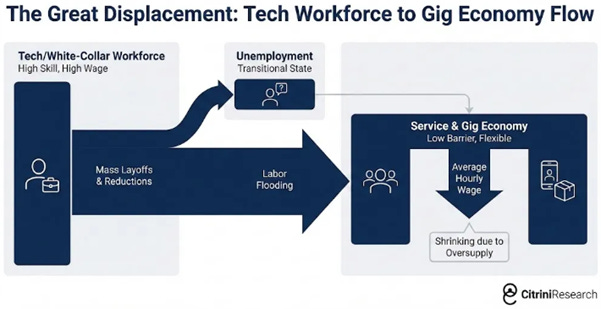
The net gain, while promising for the world, may prove to be of little comfort to the hundreds of millions of people in white-collar jobs whose livelihoods is threatened by the ArtificialIntelligence. The anxiety related to this question was perfectly illustrated in the recent thought piece by Citrini Research.1 which painted a disturbingly realistic picture of AI impact on jobs currently employing millions of people. The market reacted to the publication by taking roughly $300 billion from the valuation of the sectors directly mentioned in the report.
In response, I’ve decided to look for “comfort” in the studies of the industrial revolution to see if anything from those two periods can help us understand and prepare for what’s coming.
The industrial revolution that took place between 1750 and 1850 started with inventions of machines that allowed for transfer of manufacturing from homes to factories. It also replaced human and animal muscle with inanimate force driven by steam engines. The machines generated significantly more power than any individual human or horse and harnessed that energy to increase the production of goods that had previously been made on a small scale by hand.
The innovations, such as the spinning jenny for weaving, were a clear improvement on existing methods. They also threatened artisans employed in the manufacture of various goods, who could not compete with the new technologies. At the time, nearly 10% of the British population was employed in hand-spinning, and the potential social and economic impact of their job losses was top of mind for both those affected and the country’s leadership.
Despite the threat to existing jobs, by the early 19th century, England provided an institutional framework for the entrepreneurs willing to risk their capital on the new, more productive machines. The initial attempts to hold the innovation back, either through regulatory means2 or through outright destruction (the Luddite movement) gave way to acceptance of the inevitability of progress.
In terms of its impact on workers, the Industrial Revolution can be divided into several phases. The initial stage, in which traditional at-home manufacturing methods became obsolete, led to stagnation in real wages and quality of life. This stage lasted from 1780’s until approximately the 1820s. Following that, once the labor pool had a chance to adjust to new means of production, wages grew rapidly while the cost of living decreased, leading to significant improvements in quality of life.3
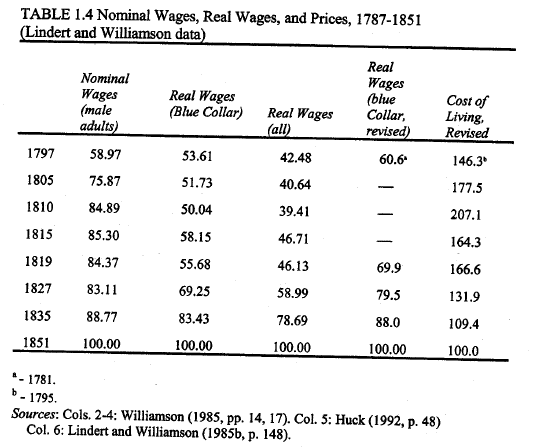
France, at the same time, was undergoing the more traditional form of Revolution where the main innovation was the guillotine. Due to lack of established institutions it was unable (or unwilling) to create the same conditions for modernization. Incidents of machine destruction occurred much more frequently and with greater intensity.4 Due to lack of protection, enterpreneurs were less willing to risk capital on the new machines. The difference in approach led to urbanization and increased economic growth in England, with GDP and real wage growth accelerating throughout the 19th century while France lagged in development.
The wage stagnation that accompanied the early stages of the industrial revolution came from conditions similar to those imagined by the Citrini Research paper: a replacement of existing form of production with a more efficient kind. Vast number of previously employed were being displaced by the innovation and forced to accept either lower wages or join the masses looking for jobs.
However, it’s the conditions that led to the acceleration in productivity in the second stage of the industrial revolution that give reason for optimism. A paper by two Harvard economists5 examines the evolution of manufacturing from artisanal shops to factories and later assembly lines. The period described in the Harvard paper (1910-1930) was one of rapid innovation that led to the mass availability of automobiles, airplanes, aluminium, appliances, and other things that start with the letter A.
The economists point out that while in the early stages demand for labor went down, factories, to get the most out of the capital spent on setting them up, needed highly skilled machine crews and craftsmen to maintain the machines. These new occupations, due to significantly higher production output, paid laborers more than they could have earned just a few decades earlier.
In exchange for higher earnings, employers expected employees to have skills that weren’t necessarily in demand earlier. Factory workers were expected to read manuals, understand chemistry and electricity, and use algebra to complete tasks. Schools adapted to these demands, and as a result, society as a whole benefited. All this came about thanks to capital investment and a highly trained workforce that was earning a return on the extra time spent in school.
I think the potential impact of the AI revolution is similar – technology is aiming to replace human cognition, which will affect the white-collar workplace and the jobs that are easiest to replicate. But as a result, service products that in prior years were only available to a select few will become much cheaper to produce. With lower costs, demand will skyrocket, and the systems producing these products will require skilled workers trained to get the most out of these machines.
Examples of France and England in the 19th century show that stopping technological innovation is impossible. If one is unwilling or unable to adopt the new technology because of fear of disruption, the disruption will happen anyway, but someone else will benefit, and the party trying to hold on to the status quo will find itself in a long-term structural disadvantage.
Takeaways:
- Industrial Revolution initially led to wage stagnation and job losses, but eventually created a higher-skilled labor class, benefiting from higher earnings and lower cost of goods
- Attempts to hold back innovation through regulation or outright hostility will likely lead to structural competitive disadvantage
Disclaimer6

The initial patent application for the first stocking frame in 1589 was famously denied by Queen Elizabeth I on the account that the invention “would assuredly bring the poor subject to ruin by depriving them of employment, thus making them beggars”
Mokyr, J, The New Economy History and the Industrial Revolution.
Horn, J. (2005). Machine-breaking in England and France during the Age of Revolution. Labour/Le Travailleur, 55, 145–169.
Goldin, C., and L. F. Katz. 1998. “The Origins of Technology-Skill Complementarity.” The Quarterly Journal of Economics 113 (3) (August 1): 693–732.
The information contained in this post is provided solely for informational and educational purposes and should not be construed as investment advice, a recommendation, or an offer to buy or sell any security. Nothing herein should be interpreted as an offer to sell or a solicitation of an offer to purchase any interest in any fund, vehicle, or strategy. Any such offering may only be made pursuant to formal offering documents and only to persons who are “accredited investors” as defined under Regulation D, Rule 501 of the Securities Act of 1933, in connection with a private offering conducted under Rule 506(b), and who also meet the requirements of Section 3(c)(1) of the Investment Company Act of 1940 or any other applicable exemption.
The views expressed represent the author’s opinions as of the date of publication and are subject to change without notice. The author has no obligation to update, amend, or supplement the information contained herein. Certain statements may constitute forward‑looking statements, which are inherently uncertain and involve risks, assumptions, and factors that could cause actual outcomes to differ materially.
Any references to past performance, investment examples, or specific securities are for illustrative purposes only and do not indicate or guarantee future results. The discussion of any strategy, concept, or thesis is not a recommendation or endorsement and should not be relied upon when making investment decisions. All investments involve risk, including the potential loss of principal.
Readers should conduct their own independent analysis and consult with their own financial, legal, tax, or other professional advisors before making any investment decision.