Q2 2026 Market Commentary

If on January 1st we had asked the following question – “What is your prediction of index performance assuming that 1) in the first six months of the year the top 10 S&P 500 companies are up 2% on average and 2) 20% of the world’s oil and gas output was disrupted by war?” – I doubt many people would answer – up 10%!
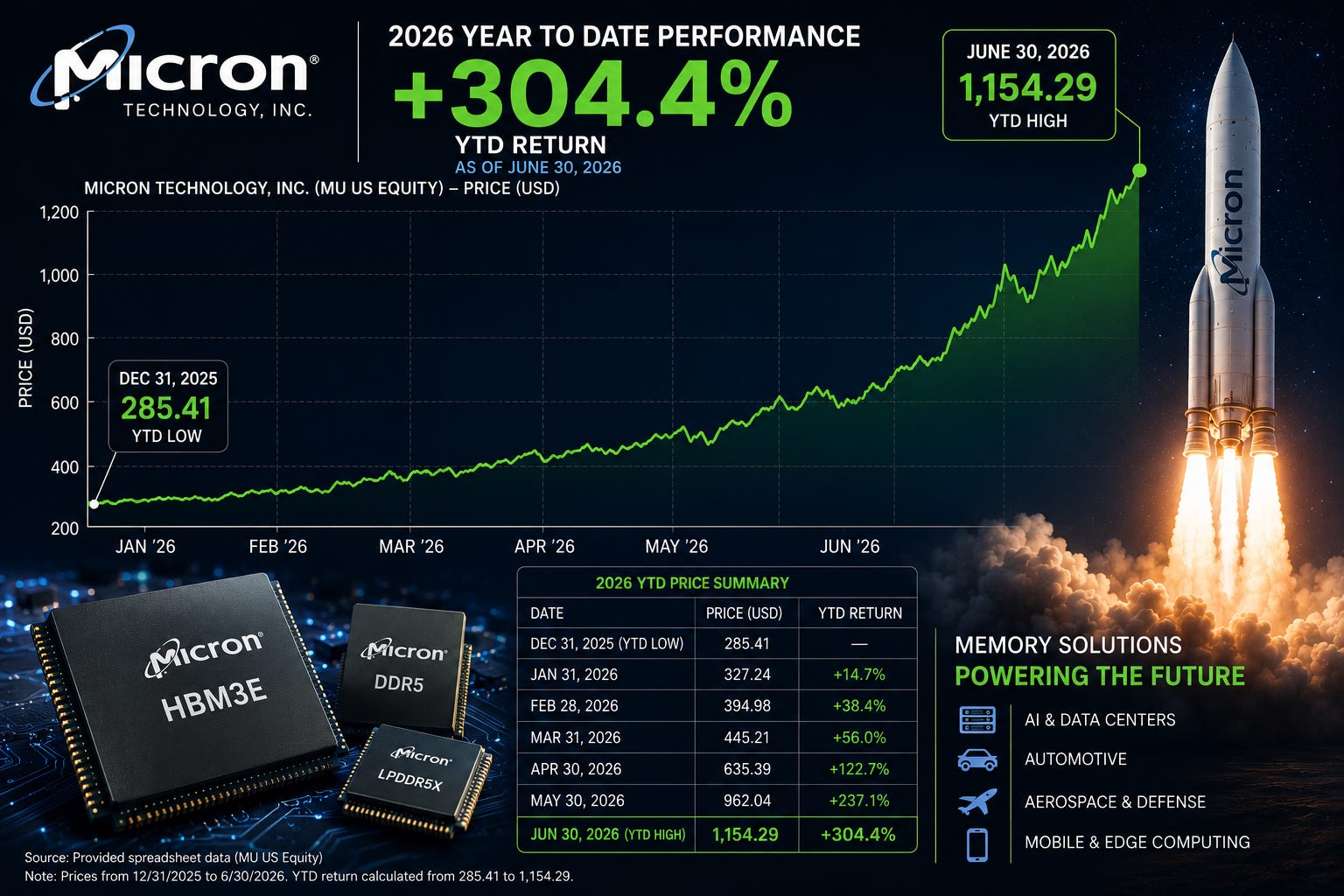
In the first half of this year, the performance leadership mantle passed from the largest companies to the companies making hardware for the AI arms race. While it is still uncertain whether the companies that are spending trillions of dollars on AI infrastructure will earn a return on that investment, the market has seemingly decided that the companies providing picks and shovels for this gold rush will. Out of the 10% gain for the S&P 500 this year, roughly 8% is explained by the gains in just 15 stocks1 which are up on average more than 200%.
As amazing as this performance is, it is not entirely undeserved. Taking 13 of these companies which were not members of the $1 trillion club already, their net income and free cash have gone up by 90% and 70% respectively since the beginning of the year. However, the market cap for this group is up by 170% and free cash flow yield declined from 2.3% to 1.5%. The market is seemingly getting increasingly confident that the planned investments in AI will take place and the boom will last longer than originally expected. Given that hyperscaler budgets have so far gone in one direction, upwards, it is hard to disagree.
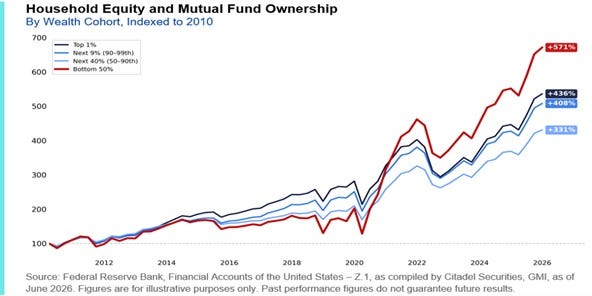
The surprising thing about this year’s market performance is that the changeover in market leaders happened without a meaningful and lasting correction. Normally, one would expect purchases to be funded by sales of existing positions, but in this case, market participants chose to hold on to the positions they had and add new money to the market. This trend can be explained by the fact that retail investors are still increasing their participation in the stock market. Moreover, within retail, the fastest growth in equity ownership is coming from the poorest cohorts, which are getting more involved in the market than usual and are the likely source of new money.
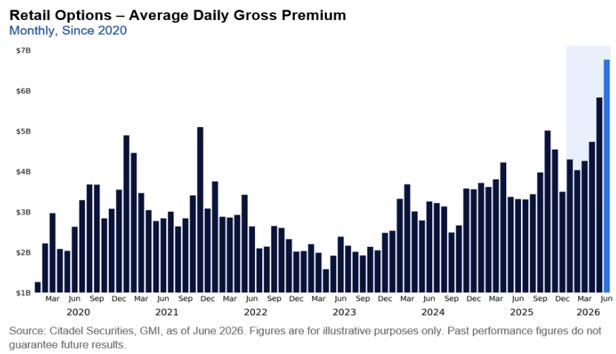
New money coming into the market does not explain the huge moves in just a few stocks, but the way it is happening probably does. We are seeing significant growth in options, especially zero-day options which provide leverage and allow punters to benefit from a short-term upward move in stocks.2[2] These options are mostly available for a few companies that capture investor imagination and are therefore driving the flows towards those select few.
Retail demand has grown throughout the year and so far, there are no signs that the market is running out of new money; in fact we are seeing the opposite. SpaceX record $75 billion listing was 5x oversubscribed and the shares jumped more than 20% on the open despite what was already a lofty valuation. Korean memory chip maker SK Hynix is currently raising $24B which would be a record for a foreign company, and this placement looks to be 7x oversubscribed as well.
It is tempting to look at these facts as signs of a bubble, however history suggests that even if it is a bubble it is not one in an imminent danger of bursting. Each period of irrational exuberance, in retrospect, had its defining moment, but probably it is not the one that we remember.
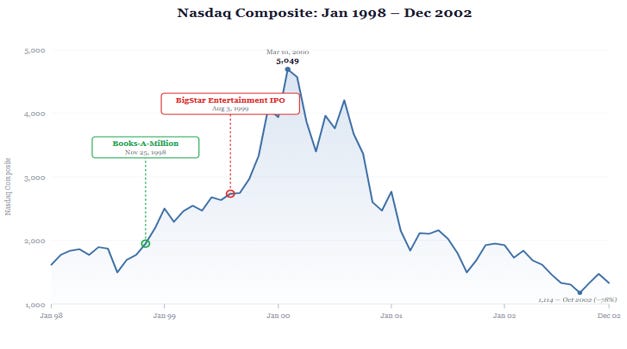
If we ask someone what they thought were obvious signs of irrational behavior back in the .com era, one would probably point to companies like Books-A-Million adding .com to their name and going up 10x in a few days after the event or Webvan which went bankrupt in 2001 listing at a multi-billion-dollar valuation and going up by 50%+ on the first day.
I would argue that a more likely signal for imminent market collapse was not when a company with .com in the name went up 10x, but when it didn’t. A company called BigStar Entertainment, which was an online retailer of DVDs, listed its shares in August 1999. Given its business model, the expectation was that this will be another company that will likely see its valuation expand dramatically on the first day of trading. However, it did not. The company listed its shares at $10 and finished its first day of trading slightly above $8 per share. The lack of an IPO pop suggested that markets were getting closer to the level where supply and demand for internet related stories was finally approaching equilibrium.
Even the failed BigStar IPO was not the moment when the bell was rung on the .com bubble. That happened six months later and at a level nearly double that of the day when BigStar Entertainment failed to pop.
Coming back to today, companies spending trillions of dollars on AI infrastructure are doing so with the expectation of a payback on this investment. In theory, the payback can come either from an acceleration in global economic growth (increasing the pie) or from a portion of existing economic activity being taken over by artificial intelligence and getting rewarded for it.
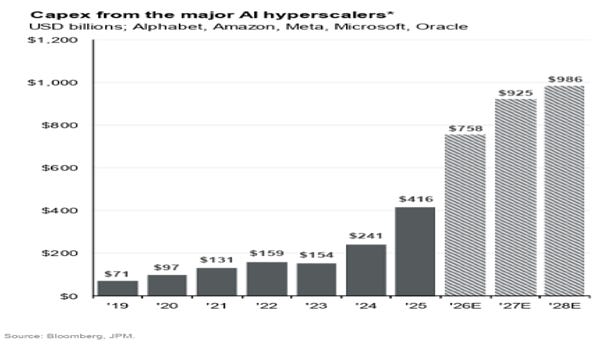
As large as a trillion dollars sounds, it’s a relatively small percentage of global GDP today which is estimated to be roughly $125 trillion. Based on current use cases, the capital invested in AI infrastructure is likely to be useful for at least five to seven years meaning that each trillion invested needs to generate roughly $150 to $200 billion of economic value per annum for the investment to make sense.
According to a 2011 McKinsey study, the internet contributed 0.4%-0.8% to economic growth of the mature economies between 1995 and 2009.3[3] Given Artificial Intelligence usefulness, the assumption that it will contribute at least 0.5% to global economic growth is not a heroic one. For a $125 trillion global economy this means a contribution of $625 billion which is well above the $150 to $200 billion needed for the investments to make sense.
While the market appears to be pricing AI infrastructure companies as the likely be the winners of this investment boom, it is also hard at work figuring out the losers. The primary candidate so far has been the software sector which until recently has been one of the market darlings. The sector overall is down by more than 20% this year while some companies such as Intuit and Trade Desk have more than halved in value.
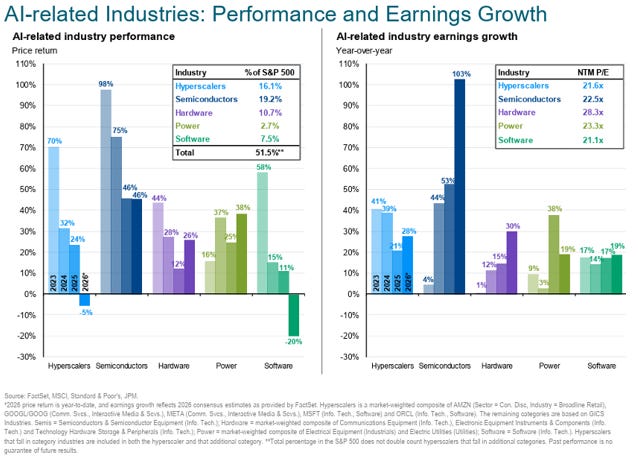
The reason why the market has decided that the software sector is at risk is similar to why retailers ended up the primary casualty of the internet. The internet made it easier for new retailers to reach customers and for consumers to compare prices, compressing margins across the industry. Likewise, AI has the potential to reduce the cost and complexity of building software, making it easier for new competitors to emerge and weakening the pricing power of established vendors. Technology dramatically lowers barriers to entry and is shifting bargaining power away from incumbents.
However, just like with the internet, incumbents that embrace the new technology have the potential to not just effectively defend themselves but also to benefit in the long run. Retailers such as Home Depot used the internet to improve inventory management, logistics, and omnichannel capabilities and ultimately came out stronger than they were before the internet. Home Depot’s operating margin today is well above that which it generated in the 1990’s.
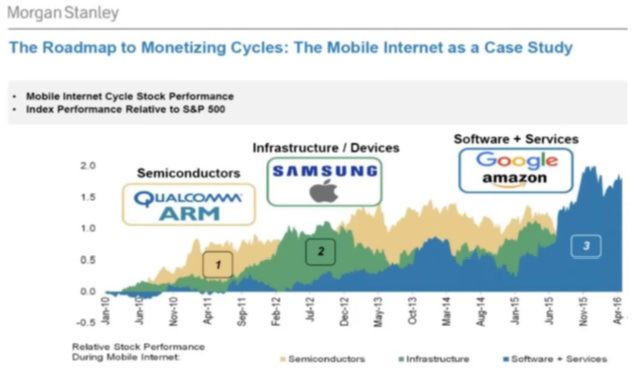
In previous technology cycles market leadership has shifted from infrastructure, to hardware, to software as companies have adapted and learned how to utilize emerging technologies. We think that the AI cycle is going to be no different. While infrastructure is being built out most immediate beneficiaries are the picks and shovels providers, but over time companies that are enhancing their profitability must emerge to justify the technology investment in the first place. Time will tell but I believe that companies with an incumbent competitive advantage that are smart about learning and adapting new technologies early have the best chance of benefitting from new capabilities.
Disclaimer4
15 companies are Micron, AMD, Intel, Applied Materials, LAM Research, Sandisk, KLA Corp, Broadcom, Cisco, Western Digital, Seagate Technologoies, Corning Inc, Palo Alto Networks and Dell. Nvidia and Broadcom are excluded when calculating metrics for the 13 companies.
https://www.citadelsecurities.com/news-and-insights/global-market-intelligence/1h-2026-market-structure-flows/
https://www.mckinsey.com/~/media/McKinsey/Industries/Technology%20Media%20and%20Telecommunications/High%20Tech/Our%20Insights/Internet%20matters/MGI_internet_matters_full_report.pdf
The information contained in this post is provided solely for informational and educational purposes and should not be construed as investment advice, a recommendation, or an offer to buy or sell any security. Nothing herein should be interpreted as an offer to sell or a solicitation of an offer to purchase any interest in any fund, vehicle, or strategy. Any such offering may only be made pursuant to formal offering documents and only to persons who are “accredited investors” as defined under Regulation D, Rule 501 of the Securities Act of 1933, in connection with a private offering conducted under Rule 506(b), and who also meet the requirements of Section 3(c)(1) of the Investment Company Act of 1940 or any other applicable exemption.
The views expressed represent the author’s opinions as of the date of publication and are subject to change without notice. The author has no obligation to update, amend, or supplement the information contained herein. Certain statements may constitute forward‑looking statements, which are inherently uncertain and involve risks, assumptions, and factors that could cause actual outcomes to differ materially.
Any references to past performance, investment examples, or specific securities are for illustrative purposes only and do not indicate or guarantee future results. The discussion of any strategy, concept, or thesis is not a recommendation or endorsement and should not be relied upon when making investment decisions. I, Firebird, and accounts managed or advised by Firebird may hold positions in companies mentioned here. All investments involve risk, including the potential loss of principal.
Readers should conduct their own independent analysis and consult with their own financial, legal, tax, or other professional advisors before making any investment decision