How Phillippe Laffont taught me to use my imagination
Why understanding long-term earnings power beats short-term metrics


In stark contrast to college or business school years, where you pay someone to acquire knowledge that later on proves more or less unnecessary (when was the last time you had to calculate the area under a curve?), one of the best things about an investment professional is that in some ways you get paid to learn things that prove useful time and time again.
One of the memorable “lessons” for me was the 2015 edition of the annual Graham & Dodd Breakfast, organized by Columbia Business School, where Phillippe Laffont from Coatue Management spoke about his investment philosophy. This event was so important because Mr Laffont’s investment style is so different from mine. He is one of the most successful growth investors, while my style is best described by my friend Vitaliy Katsenelson as that of a “Paranoid Russian (or Belorussian) Jew.”
The key message from Phillippe was to value the company using the company’s estimated earnings power five or ten years down the road, which he illustrated with the example of NFLX, which at the time was trading at a healthy 400x multiple of earnings. The company had roughly 75million subscribers and an average revenue per user of just over $8.
The question is whether a company like Netflix can have 400 million subscribers in ten years and an ARPU of $20. Given its fixed cost base, if the company got anywhere close to these numbers, then the multiple you were paying in 2015 on 2025 earnings was around 2-3x, which seemed a lot more attractive.
Netflix ended 20241 with roughly 300 million members and an estimated ARPU of $11.70, which was a bit off from Mr. Laffont’s hypothetical, but directionally his point proved correct since over the nine years Netflix earnings increased over 30x and the shares delivered a 25% annualized return.
A year or so after hearing Phillippe Laffont speak, I had a chance to apply that way of thinking to an investment that I was considering – Facebook. The company, at the time, had been listed for about 5 years and had delivered 9x revenue growth and 6x operating profit growth over that period. Despite (or maybe because of) the track record of success, the market was starting to get nervous about the sustainability of this growth, and the shares had sold off to a “value” multiple of just 20x EV to EBITDA.
Given that Facebook already had over 1.2 billion daily active users, concerns about the runway in user growth could have been justified. Still, the part that I felt the market was underappreciating is the pricing power that Facebook had.
In 2015, digital advertising accounted for roughly 30% of overall advertising expenditure. At the time, its average revenue per user was $20 in North America and just under $6 overall.
Digital advertising solves the fundamental problem of advertising best illustrated by John Wanamaker’s quote:
“Half the money I spend on advertising is wasted; the trouble is I don’t know which half.”
Merchants that are spending money on Facebook or Google or other digital platforms can track exactly how much sales are generated from these ad placements and calculate the return on investment. There was no reason why this superior product wouldn’t eventually reach a dominant share of advertising budgets.
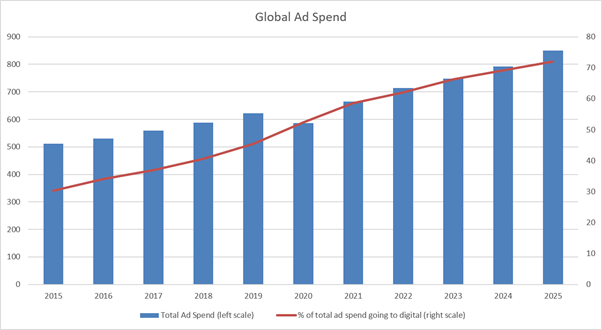
In this case, the thesis largely played out, though not necessarily for all of the reasons that I had expected at the time. Over time, digital advertising gained share of the overall market, with total spend growing by 14.7% p.a. compared to just over 5% for the advertising market2. By 2025, more than 70% of total advertising spend is going to digital. Facebook/Meta has done even better with advertising revenues growing by 27% per annum.
The reason for Meta’s outperformance is the company’s careful nurturing of its ecosystem, which ensures that users continue to engage with Facebook, WhatsApp, and Instagram while advertisers get a return on their dollars spent. The fact that most people were already using one of these social networks was the draw for everyone else.
While the company has received its fair share of criticism for hosting viewpoints that foster extremism and allow external actors to influence domestic politics, Facebook, Instagram, and WhatsApp have also become the global townhalls that helped organize democratic movements or were used by volunteers helping people in various conflicts or calamities happening around the world. Moreover, Meta’s scale and billions spent on community relations (monitoring) probably led to less negative content online than otherwise would have been there.
Despite increasing competition from Snapchat, TikTok, Twitter (X), and other social media platforms, Facebook’s daily active users continued to grow. By 2023, it grew to over 2.1 billion (25% of the world’s population). By the end of 2025, over 3.5 billion people used at least one of Meta’s social media properties (Facebook, WhatsApp, Instagram, Threads, etc.)
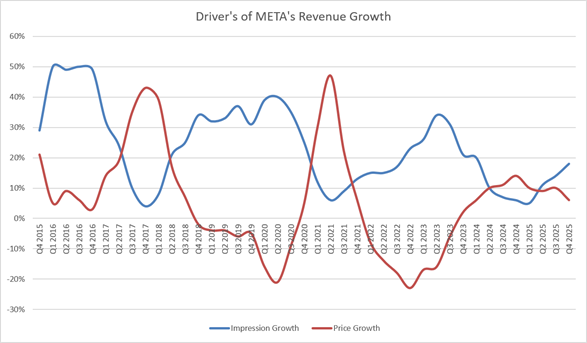
Separately, in dealing with advertisers, Meta made a conscious decision to throttle its revenue growth and profitability. Given the high ROI digital advertising was generating, Meta could have easily increased ad prices whenever it wanted. Still, it seems to preserve pricing power during periods when impression growth slows. As a result, advertisers have been getting consistent value for the dollar spent, and the company has shown a smoother revenue stream that investors appreciate.
The revenue growth translated into strong profits and gains for shareholders. Between 2015 and 2025, revenue grew close to 11x, and cash flow from operations grew over13x3, thanks to a fixed cost base spread over higher revenues. The company achieved these results despite increasing spending on community relationships (monitoring) and R&D at a pace that outpaced revenue growth. Shareholder returns compounded and just over 20% over the same decade.
Predicting any company performance over a ten+ year period is usually a fool’s errand. As I discussed in earlier article over a decade, the company could become unrecognizable through changes to business model and/or M&A activity. That said, asking the right question about market potential can help uncover situations in which a company with existing competitive advantages can continue to thrive, benefiting both its employees and shareholders.
Disclaimer4
Netflix stopped reporting ARPU and membership numbers beginning in Q1 2025.
Source: WARC Media
2015 Revenues and Operating Cash Flow $17.9B and $8.6B respectively. 2025 Revenues and Operating Cash Flow $201B and $115.8B respectively.
The information contained in this post is provided solely for informational and educational purposes and should not be construed as investment advice, a recommendation, or an offer to buy or sell any security. Nothing herein should be interpreted as an offer to sell or a solicitation of an offer to purchase any interest in any fund, vehicle, or strategy. Any such offering may only be made pursuant to formal offering documents and only to persons who are “accredited investors” as defined under Regulation D, Rule 501 of the Securities Act of 1933, in connection with a private offering conducted under Rule 506(b), and who also meet the requirements of Section 3(c)(1) of the Investment Company Act of 1940 or any other applicable exemption.
The views expressed represent the author’s opinions as of the date of publication and are subject to change without notice. The author has no obligation to update, amend, or supplement the information contained herein. Certain statements may constitute forward looking statements, which are inherently uncertain and involve risks, assumptions, and factors that could cause actual outcomes to differ materially.
Any references to past performance, investment examples, or specific securities are for illustrative purposes only and do not indicate or guarantee future results. The discussion of any strategy, concept, or thesis is not a recommendation or endorsement and should not be relied upon when making investment decisions. All investments involve risk, including the potential loss of principal.
Readers should conduct their own independent analysis and consult with their own financial, legal, tax, or other professional advisors before making any investment decision.